American Politics: From Tariffs to Factory Building—Inviting the Wolf In or Reindustrialization?
9/29/2026#赴美建厂#再工业化#产业竞争#国际观察
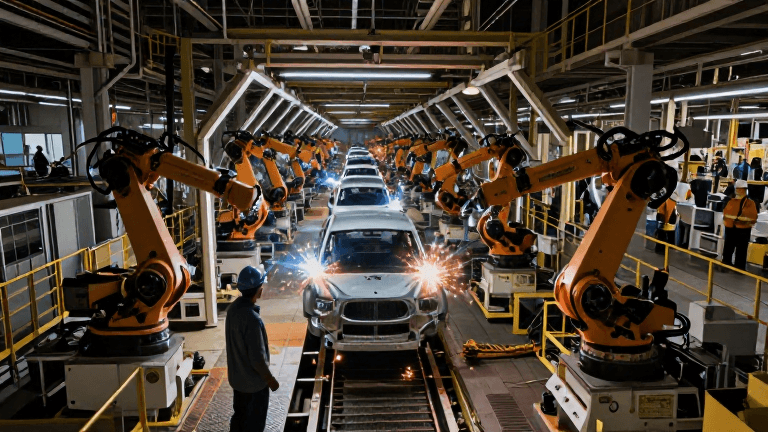
Everyone, after round after round of trade wars and tariff wars, not only has China not been crushed, but the American political scene has caught a whiff of a new trend—from strictly guarding against Chinese companies, it has made a 180-degree turn and started calling for us to go build factories. Last month in Detroit, the Motor City, Trump stated: if Chinese companies build factories and hire local workers, that's a good thing, let China in, I like it. Seeing the wind about to change, another group is anxious: letting Chinese automakers into the US is inviting a wolf into the house, the American auto industry will be wiped out, and this idea must be nipped in the bud.
Let's first look at the supportive faction. They believe that Chinese manufacturing factories have not put American workers to work enthusiastically; instead, they have reduced 68,000 manufacturing jobs, and manufacturing's share of the labor force has dropped to 8%. So, letting Chinese companies come to the US to set up factories is just returning manufacturing jobs to the US, right? This is simply a multi-benefit move of technological poverty alleviation, boosting employment, and selling assets locally. Economist Noah Smith's point here is quite reasonable.
But the opposition won't have it. They believe the US market is limited and will not generate new demand or new jobs by bringing in Chinese companies. The representative of this faction, Robert Atkinson, president of the tech policy think tank ITIF, is resolute and firmly opposes Chinese companies, especially auto companies, building factories in the US. He has four reasons: First, the US market pie is limited; bringing in Chinese companies is just redistribution and will not bring new job opportunities. Second, China's success relies on decades of mercantilist policies—this term is not well translated; to put it plainly, it's economic nationalism, where the state steps in to cultivate industrial champions—how can the US reward this behavior with market access? He is right about one thing: we must recognize that the US market is neither infinite nor open, and must cultivate new markets to absorb capacity. Last year we did well on this point, with outward direct investment of $124 billion, an 18% increase over the previous year, the highest level since 2018. Third, the expansion of Chinese companies will keep high-value-added jobs within China, leading to the loss of high-end jobs in the US. Fourth, US dependence on China's key technologies will threaten national security and economic resilience. Finally, the US in the past transferred low-end industries and retained a strong innovation ecosystem; now letting low-end industries in will only weaken US innovation capacity.
Everyone, these opposition remarks are truly laughable and exasperating. They style themselves as Hamiltonians, in a way like someone disappointed in a promising student, hoping the US becomes like China and implements more active industrial policies—they also want to take stimulants, they also want to be a martial arts team, and they only stop us because there cannot be two suns in the sky. Such people speak harshly, but at least they are clear-headed opponents: with the competitive level of American automakers competing against Chinese automakers, it's like a normal team going up against a martial arts team on stimulants—it won't promote competition, it will only be a one-sided massacre.
The opposition also raised an interesting point. They say that in the tech-economic trade war, the US cannot win, but must avoid losing and avoid becoming the next Britain. To this end, the US needs a comprehensive transformation into national power capitalism, with the government formulating industrial strategies in key economic sectors, because the market alone is insufficient to cope with state-supported competition. This is essentially benchmarking China's approach, because it is a more suitable intermediate form for international competition. But they also pointed out a big problem: governments in Western democracies are prone to wavering back and forth, often sacrificing long-term interests for short-term approval ratings and good-looking statistics. The core reason is that the industrial cultivation cycle is far longer than the electoral political cycle. The US is not only declining in industry itself, but also in industrial workers. Cultivating talent is harder and takes longer than building factories. Therefore, a highly stable governing collective with strategic vision is indeed needed to gradually transform the nation's economic landscape from finance, real estate, and leasing back to production, construction, and innovation.
In short, this shift in the wind is a bit absurd, but the reasoning is not wrong: whether one can plan for the long term is the real test.