China's Agricultural Cthulhu: "Superpowers" from the Desert to the Deep Sea
9/16/2026#中国农业#农业产能#粮食安全#农业现代化
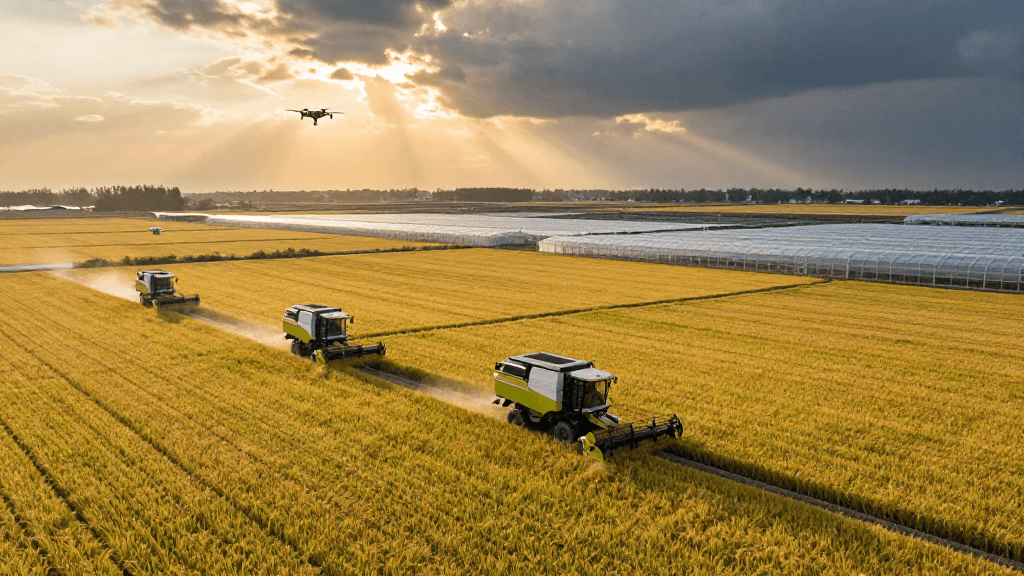
Hey everyone, let’s talk about “China’s Agricultural Cthulhu” today—it’s truly a living miracle. Did you know that China doesn’t just have an “Industrial Cthulhu,” but an “Agricultural Cthulhu” as well? Let’s start with the “Industrial Cthulhu”—it can show you the sheer power of China’s production capacity in the blink of an eye. Take those Bluetooth earbuds, for example: one fen each, free shipping, no ads, and zero cashback. It’s truly baffling, but Cthulhu is Cthulhu—you don’t need to understand it, just revere it.
But today we’re here to talk about the “Agricultural Cthulhu,” whose power is even more jaw-dropping. China’s arable land accounts for less than 10 percent of the world’s total, yet it produces nearly a quarter of the world’s grain, feeds nearly one-fifth of the world’s population, and boasts a total agricultural output of over 2 billion metric tons, with a value of 20 trillion yuan. These numbers might sound too abstract, so let’s put it another way: China ranks first in fish, poultry, meat, and eggs. As for vegetables and fruits—excluding tropical and cold-climate specialties—China essentially ranks first in all categories.
You say that’s not enough? Then let’s compare it to India. The two countries have similar populations, but India has 30% more arable land than China. So what’s the result? China produces twice as much staple grain as India, four times as many vegetables, three times as many fruits, four times as many eggs, and a staggering ten times as much meat. You say that’s not even a fair comparison? Then let’s look at global seafood consumption: out of 150 million metric tons of seafood, the Chinese consume 70 million metric tons—a 45% market share. Doesn’t that seem a bit outrageous? After all, in most countries, if you want to eat seafood, you have to go out to sea to catch it, right? How much you catch depends on the whims of nature. In China, however, most seafood is farmed in marine aquaculture facilities—you can harvest as much as you want.
Since 1983, China’s aquaculture output has exceeded its catch, leading the world by a full 30 years. In terms of agricultural practices, a Cambridge PhD in computer science wrote an article titled “How the Appetites of 1.4 Billion People Are Satisfied,” which details technologies such as cage aquaculture, solar-powered fish ponds, and vegetable greenhouses. Now, the “Agricultural Cthulhu” has evolved to incorporate AI-driven intelligence. Take marine aquaculture, for example: there are over 200 national-level marine ranches stretching from the Bohai Sea to the South China Sea, with Shandong having the most—Qingdao alone boasts 22, living up to the reputation of Gala Ha beer.
Today’s consumers are no longer satisfied with aquaculture in nearshore tidal flats; they now demand deep-sea and offshore aquaculture specifically for high-value species such as salmon, yellow croaker, and grouper. Deep-sea and offshore aquaculture involves complex environments and requires extremely high technical expertise. It integrates technologies from marine engineering, biotechnology, materials science, new energy, underwater robotics, and remote monitoring systems. Last year, with the support of the Central Government’s Document No. 1, more than a dozen large-scale deep-sea aquaculture platforms were launched, delivered, and put into operation. Take Zhuhai’s “Geshen No. 1,” for example: its overall frame is as large as seven basketball courts and as tall as a five-story building, with a water capacity of 30,000 cubic meters. It operates entirely on AI, with temperature and oxygen levels automatically monitored and regulated; feed is delivered by drones, and the entire system is powered by photovoltaic energy.
As technology evolves and the industrial chain integrates further, fully unmanned fish farms will undoubtedly emerge. If you want to eat fish, you can simply “fish from the seabed”—processed and delivered via cold chain right to your door. You won’t even know how it was done; you’ll just sign for the package. To be honest, though, marine fish farming has yet to push the boundaries of human imagination. Some of the practices currently being carried out in China are truly outrageous—take desert fish farming, for instance, which exports seafood from Xinjiang to Singapore and Malaysia, showing a complete lack of basic respect for natural endowments. In Tibet, where fish consumption is only one-sixtieth that of Zhejiang, they’ve actually converted saline-alkali land on the edge of the desert into fish ponds. They filter and adjust the mineral content of highly saline groundwater, dilute it with melted snowmelt from the mountains, then add microbial cultures. Combined with aerators, recirculating water systems, electric heaters, automatic feeders, and ultraviolet lights that simulate ocean lighting, they’re able to specifically farm high-value seafood.
Examples like this are countless—there’s nothing that can’t be done if you can imagine it. A Financial Times reporter interviewed an Iranian businessman in Midu County, Yunnan, who was growing cherries there—a place where cherries don’t naturally grow because it’s too dry and too hot. So what happened? The government built industrial cold storage facilities to simulate winter conditions and laid pipes from the mountains to provide irrigation water—and the cherries actually grew, leaving the business owner completely dumbfounded. This is the kind of achievement a centralized state can deliver.
Nowadays, many foreigners come to China to dine out or browse the farmers’ markets and are utterly shocked—I hardly ever watch those kinds of videos. There are also quite a few serious educational videos exploring the modernization of Chinese agriculture, where people try to understand this phenomenon—and the country itself—as technology continuously upgrades and output keeps climbing, yet we’ve gone from being largely self-sufficient in agriculture 25 years ago to now having to import more than 20 percent of our agricultural products. What kind of situation is this, where even “agricultural Cthulhu” has to give it one more push?
Actually, there’s no “Cthulhu” at play here. All these seemingly inexplicable innovations stem from the advantages of the system and institutional mechanisms, combined with the collective creativity of hundreds of millions of people in the sector—including farmers, entrepreneurs, and researchers. Their ability to adapt flexibly and continuously optimize processes is the key to driving the transformation of traditional agriculture into a precise and efficient system.