The Zhunde Coalfield: Our “Zhunde Middle East”
9/15/2026#能源安全#准东煤田#煤化工#新疆
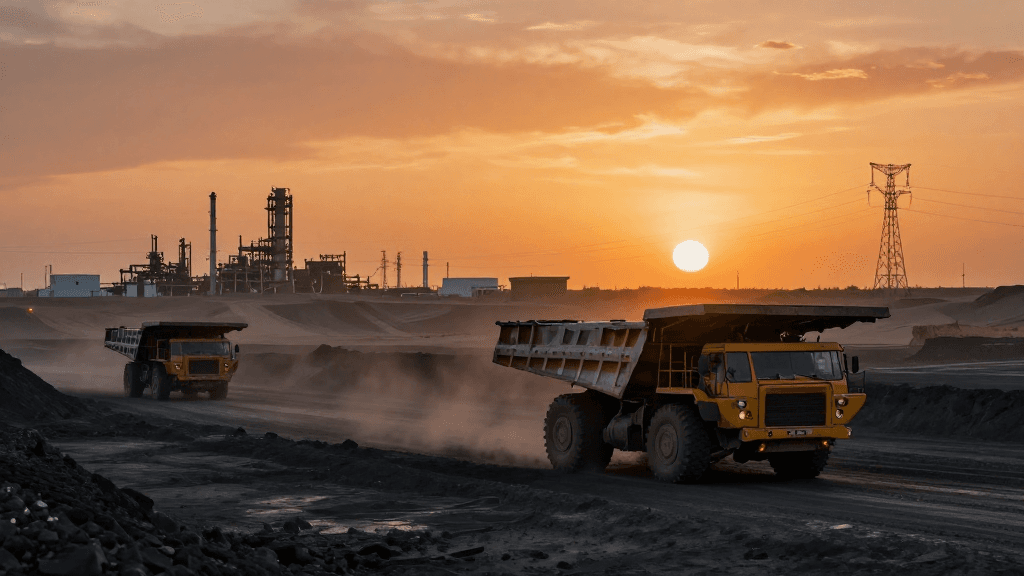
Hey everyone, did you know? Lately, our local coalfield—called Zhundong—has been making just as much of a splash as the “Middle East.” Right now, the Middle East is in complete chaos; as soon as the straits are closed off, energy supplies to many countries are cut off, and they’re all crying foul. As a major industrial nation, can’t we have our own “Middle East”?
The Zhundong Coalfield is located in the southeastern corner of the Junggar Basin in Xinjiang, east of Urumqi and north of Turpan. It doesn’t produce oil, but it does produce coal. Its estimated reserves alone total 390 billion metric tons—more than the combined reserves of the Powder Valley Basin in the United States and the Kuzbass region in Russia. Currently, proven reserves exceed 250 billion metric tons; with shallow, thick coal seams, the potential for extraction is naturally enormous. These figures may sound somewhat abstract, but in terms of calorific value, the energy content of 390 billion metric tons of coal is equivalent to 117 billion metric tons of Middle Eastern crude oil.
Does that mean we’ll switch entirely to coal? Not exactly. Modern industry requires raw materials with a high hydrocarbon-to-carbon ratio, and crude oil holds an advantage in this regard. Therefore, coal chemical processes must undergo hydrogenation to reduce carbon content, which is energy-intensive, water-intensive, and results in high carbon emissions. The initial investment in fixed assets alone requires a massive outlay, and transportation costs are high—road transport is more expensive than sea transport. As a result, the world has developed a path dependence on Middle Eastern crude oil.
Now that geopolitics has thrown a wrench into the works, the oil and gas, petrochemical, and coal energy sectors are facing unprecedented opportunities. Global demand for coal may reach a new high this year. During the oil crisis of the 1970s, the coal industry—especially coal-fired power generation—boomed; this time, it’s the turn of coal chemical industry. Originally intended as a strategic alternative to the petrochemical industry, today China is virtually the only country still investing heavily in coal chemical industries.
The conflict in Iran has taught countries a lesson: once chemical production grinds to a halt, even manufacturing items like plastic wrap and trash bags becomes difficult—yet China remains unfazed, precisely because of its coal chemical industries. Countries like India want to emulate China, but it’s not something you can just pick up overnight. India’s coal has a high volatile matter content, and its technology has stagnated. In contrast, China has been refining the core technology of modern coal chemical industry—the Fischer-Tropsch process—for decades.
When India proposed developing coal chemical industries in 2020, companies paid it no mind. It wasn’t until strategic necessity compelled the government to act that the project finally got off the ground—after the government quadrupled its financial support and agreed to cover 20% of the construction costs. China’s energy technology revolution has proceeded in an orderly and systematic manner. The South China Morning Post published an in-depth report on the Zhundong Coalfield, detailing how China is using cutting-edge technology to unlock its resource endowments and reshape the foundation of national energy security.
The Zhunde Coalfield is divided into five mining areas, covering a total area of 42,000 square kilometers, with a core area of 15,000 square kilometers. It is a national-level economic and technological development zone that integrates six sectors: mining, coal-fired power generation, chemical processing, metallurgy, new materials, and new energy. Development of the coalfield began in 2006, and the development zone was officially approved in 2012, but its rapid growth has only truly accelerated in recent years. As heavy industry has moved in, the once-barren land has rapidly urbanized, giving rise to shops, residential areas, and airports—among which the Wucaiwan General Aviation Airport is set to begin operations soon.
Advanced technologies are widely used in the coal mines. For example, there are unmanned mining trucks that operate automatically around the clock. While the scene appears bustling with trucks, they are all driverless electric vehicles that navigate automatically and can have their batteries swapped in just six minutes; a fleet of over a hundred vehicles requires only four people to manage. The coal mines aim to achieve 90% electrification by the end of the year—but where does the electricity come from? It comes from the mine’s own power plant. Many large mines in the Zhundong Development Zone are both electrified and automated.
Simply selling coal directly isn’t a profitable business—at 400 yuan per metric ton, transporting a single railcar load doesn’t yield much profit. Therefore, the region has integrated the entire process—from mining to power generation, chemical processing, and advanced materials manufacturing—to form a high-value-added industrial cycle. First comes power generation; the industry’s leading companies are all concentrated here. After coal-fired power is generated, it passes through the Changji Converter Station, where it is bundled with wind and solar power, transmitted via a ±1,000-float ultra-high-voltage line, and transmitted in 0.01 seconds to Anhui, 3,000 kilometers away. This is the world’s supergrid with the highest voltage level, the largest transmission capacity, and the longest transmission distance; the electricity it carries can meet the annual electricity needs of 133 million households.
Large quantities of coal are used directly to produce chemical products—specifically, coal-to-liquid (CTL) and coal-to-gas (CTG), which serve as the most direct substitutes for imported oil and natural gas. The coal-to-liquid facility is located in Hami, where the world’s most advanced CTL technology converts coal into liquid fuels, which are then refined into gasoline and diesel. Three major coal-to-gas projects are currently under construction, each with an annual production capacity of 21 cubic meters. Upon completion, Xinjiang will become the nation’s largest coal-to-gas production base. The coal-based chemicals and new materials industries produce, for example, basic raw materials for plastics and absorbents; urea and melamine for fertilizers; coal-to-methanol; and biodegradable coal-based POE, among others.
Finally, there is the integration of new energy sources: Xinjiang has abundant wind and solar power, which can be used to produce hydrogen. This hydrogen is then incorporated as a feedstock into the coal chemical process, helping to overcome the issues of high energy consumption and high emissions associated with coal chemical production. This synergy among industries is a prerequisite for efficient energy utilization, sustainable project development, and long-term industrial profitability. Centered on self-reliant and controllable coal-based energy, the Zhundong Economic Development Zone has established a vast modern industrial system ranging from basic fuels to high-end new materials. With long-term development, this system will resolve the constraints posed by limited water resources and become a strategic industrial base for China’s self-reliant and controllable chemical industry.