Today's Eel Feast: A Remarkable Achievement by Chinese Scientists
9/16/2026#鳗鱼养殖#水产种业#种苗繁育#日本鳗鱼饭
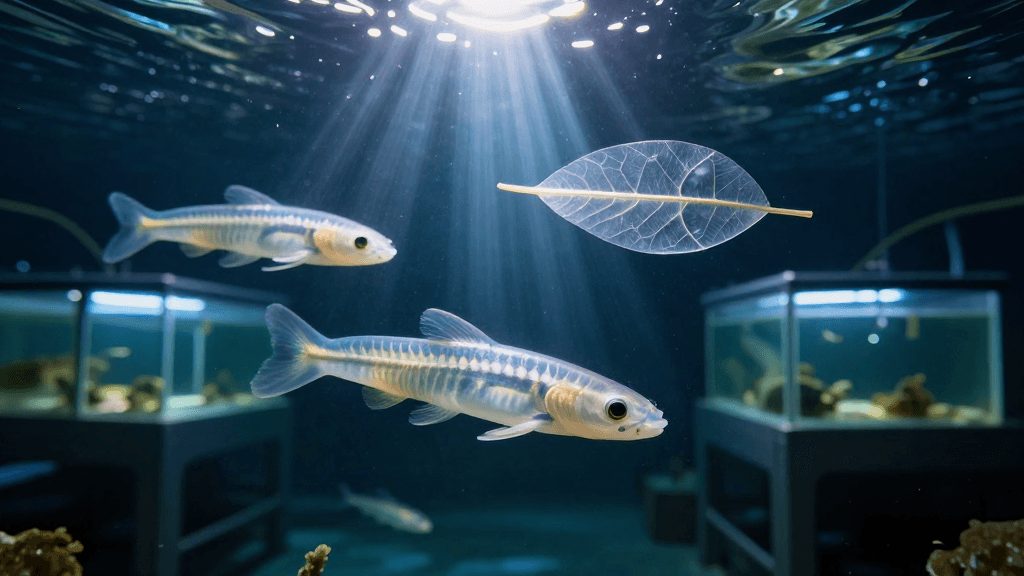
Everyone, today I’m treating myself to a rare bowl of eel rice to celebrate. As for eels, wild ones have long since disappeared from our plates, and farmed ones are entirely at the mercy of the weather. That’s because they can only be raised—not bred—and there are a whole host of breeding issues. Even an agricultural Cthulhu like China can’t get the better of a tiny little eel. But recently, our aquaculture scientists have made a major breakthrough.
The story begins in the depths of the Mariana Trench. Those larvae, as transparent as cicada wings, traverse vast expanses of azure waves toward the coast of East Asia, arriving there by the time they’ve grown into translucent, tender willow leaves. Then they swim upstream along inland rivers; the gray willow twigs gradually take on golden edges weathered by wind and rain, and they lie dormant in lakes and rivers like hermits, and ten years later, they transform into gleaming silver swords, piercing through mud, sand, and churning waves to return to the very sea where they were born, to spawn—and then die, exhausted. This is the life story of the eel. But if it is caught, that is another story altogether.
There are records of the Chinese eating eels dating back at least 2,000 years. Known as the “king of raw fish slices,” Han Xizai—in his painting *The Night Banquet*—was too reluctant to serve it to guests, yet privately craved it with a passion; his chef described it as the grand finale of the banquet. As late as the Qing Dynasty, the famous food connoisseur Yuan Mei was still expounding on the culinary theory of eel in his *Suiyuan Shidan*. However, Japan remains the true powerhouse of eel consumption. The Japanese believe eel to be a powerful tonic; they insist on eating it even in summer when it is not at its most plump, resulting in robust consumption year-round. With just 1.5% of the world’s population, they consumed 150,000 metric tons annually at their peak—accounting for 70% of global production. Wild eels simply couldn’t withstand such consumption.
Consequently, Japan began aquaculture as early as 1879. While wild catches have steadily declined, even at reduced levels, the species was still on the brink of extinction. In 2014, the eel was listed on the IUCN Red List of Threatened Species, at one point facing an even more precarious situation than the giant panda. The fact that we can still enjoy this endangered species today is thanks to China’s aquaculture industry stepping in to fill the gap. We introduced Japanese technology in the 1970s, began exporting it back to Japan in the 1980s, and now 75 percent of global production comes from China.
However, there is a long-standing bottleneck that has yet to be overcome: the inability to breed eels in captivity. In the past, aquaculture still relied on wild-caught fry; all humans could do was raise them to maturity—ultimately, we were still at the mercy of nature. What’s worse is that humans haven’t actually increased the eel population—we’ve merely redistributed the mortality rate. Fewer fry are escaping those destructive gillnets, so even fewer are able to migrate back to spawn.
Just a few days ago, Xinhua News Agency broke the news that a team led by Zhao Feng from the East China Sea Institute of the Chinese Academy of Fisheries Sciences successfully achieved artificial breeding at an experimental base at Jimei University in Fujian. More than 3,000 high-quality broodstock produced over 3 million fry, some of which have already begun feeding normally.
So how was this achieved? Previous approaches to artificial breeding relied on hormone-induced artificial insemination to produce fertilized eggs; however, due to the inconsistent quality of the gametes, both fertilization and survival rates were generally low. Zhao Feng’s team took the route of environmental simulation. In the early stages, they used satellite tracking technology to analyze the eels’ needs and feeding patterns under natural deep-sea conditions. They then transformed the indoor ponds into a replica of the Mariana Trench, simulating an environment with high pressure, low temperature, and no light. Combined with nutritional enrichment, this made the eels feel at home and secure, allowing their gonads to develop. As a result, they naturally began courting, chasing one another, spawning, and fertilizing their eggs.
It sounds simple when I describe it, but it’s actually incredibly difficult. This is because male and female eels reach sexual maturity at different rates; by the time the females are ready to ovulate, the quality of the males’ sperm has already deteriorated. Therefore, within the same system, hormone levels must be controlled with extreme precision to induce synchronized development toward sexual maturity. Now that we’ve successfully hatched the eggs and the juvenile eels have begun feeding, we’ve overcome a major bottleneck in artificial breeding. The next milestone is ensuring their survival on a large scale and successful metamorphosis. This, too, places extremely high demands on both the environment and nutrition. Once this path is successfully navigated, it will mean that in the future, fry will no longer need to be sourced from wild catches, offering hope for a complete reversal of the precarious situation facing the eel species.
Ancient people had never witnessed eels spawning and believed they clung to the backs of black fish, relying on sensory perception to overcome reproductive isolation. Later, when people understood the principle, they were still powerless to reverse the laws of nature. Seafood Watch, which compiles a list of sustainable seafood in the United States, could only advise people not to eat them in order to protect the species. Eel consumption in Japan has been cut in half compared to 20 years ago. So what about China now? There’s a saying about the “rise of the national eel”—we must not only unravel the secrets of nature but also achieve artificial reproduction. If we succeed, the day when foodies can once again enjoy eel freely may not be far off.